Wednesday, September 22, 2010
More political analysis
This time from the Christian Science Monitor. Never a dull moment in Nicaraguan politics! As a side note, there are several older stories about Nicaragua linked to this article.

Monday, September 20, 2010
Nicaragua in the news
The LA Times ran a story today about the Nicaraguan presidential elections slated for November of 2011. From what we hear on our street, among our neighbors, in taxis, and at political analysis forums, the Times reporter has painted a pretty accurate picture of what's going on in politics here.
Saturday, August 28, 2010
On our Front Porch
I love the time between 4:30 and 5:30ish on our street. Everyone is coming home from work, the babies are taking rides in their strollers, the kids are playing soccer or reading, the rocking chairs are coming out to the porches, everyone is catching up on the news of the day, and we are all sighing in relief that the worst heat is past. I caught some tears sneaking up to my eyes a couple times last week as I sat outside chatting with my neighbors, thoroughly enjoying this ritual that has become an important part of our daily life and realizing that we only have a few months left. Our porch is a good meeting place because it is an excellent height for sitting, we have a good shade tree, and it is in the middle of the street.
On our front porch . . .
.JPG)
.JPG)
there is friendship,

there is innocence,


there are babies,

there is music,


there are good times,

there is learning,

there is eating,


there is laughing,

there is mischief,
there is kissing (no picture of this, but there is plenty of it between the teenage couples hanging around on our porch),

there are paper airplanes,
there is relaxing,

there is excitement,

there is peace.
Friday, August 13, 2010
Changes
As we think about re-entering the US in 4 months, we have been reflecting on all that has changed in the realm of technology since we´ve been away. When we left:
SO, what will happen to Beth, Alan, and Simon? Will they return in their shabby, out-of-style clothes renouncing technology and begging people to put down their phones and engage them in old-fashioned real conversation on their front porch while sipping juice and sitting in rocking chairs? Stay tuned to find out . . . (ironically, through facebook and our blog :)).
-Texting was an expensive and seldom-used form of communication
-No one we knew accessed the internet from the palm of their hand
-Books were made of paper
-No one we knew had Facebook
-Twitter did not exist
-Churches had websites, maybe . . . if they did, they were generally poorly-designed and seldom-accessed
-Starting a blog felt like something new and cutting-edge
Here in Nicaragua, things are different:
-Many people have cell phones, but few have minutes to use them. Very occasionally I receive text messages from my internet-savvy friends who can go to the cybercafe and send texts for free from the cell website.
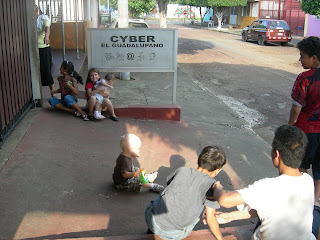
-Most people who access the internet do so from community internet cafés (less than $1 for 2 hours of internet time) like this one next to our house that opened 1.5 years ago. Even if the owners were not also very good friends of ours, I would gladly advertise their business. They are friendly, efficient, helpful, and keep their machines well-maintained. I love that using the internet has natural boundaries and limits for us here: we have to know exactly what we want to do and how long we will take (which makes for good time management), we expect that whatever we do will be observed by other neighbors and kids (which keeps us honest), and the internet time is bracketed by real conversations with our neighbors as we enter and leave.


-Books? (see our other posts about books and education, like the one below)
-Some people have Facebook, and many have Hi-5
-No Twitter that I have ever seen.
-Church websites: Why would you need a website when you see each other every day and have services 8 times per week?
Tuesday, August 03, 2010
Education in Nicaragua
I read a very thoughtful, well-written article the other day by a Nicaraguan educator giving an overview of the politics of education in Nicaragua. Some issues she points out are universal: politicians implementing flashy, short-term fixes--especially as election time draws near--at the expense of necessary, long-term policy change. Some issues are unique to Nicaragua, such as the success of the 1980s literacy campaign in contrast to the extreme lack of qualified teachers today (in 2010 no new students registered for the teacher education program). Some struggles are common to many countries trying to crawl out of poverty, although, at least in Latin America, Nicaragua is at the very bottom of the heap in terms of instructional hours, budget, and academic performance. This picture shows the new "policies" of the ministry of education to improve education. Translation: "New MINED policies: More better education, More quality education, Educating everyone, Other education."
 Three of the issues she mentions I see very clearly in my work and neighborhood: 1) lack of access to reading materials, 2) the difficulty of student retention, and 3) the shortage of instructional time.
1) Reading and writing can be difficult to teach even if one has received a quality education with ample access to books, creative problem solving strategies, and practice understanding and forming opinions about what is read. For teachers who have never had access to books or opportunities for critical analysis and writing, it becomes nearly impossible to teach these skills. Going to a local bookstore might give you an idea of the dilemma: yesterday I had the choice between a series of cheaply-made fairy tale books with mostly words and a few drawings of white people for $10 and a bright, colorful, interactive book about Diego´s adventures for $30. Very few people have even $10 to spend on a book (and why would they want to?), and any book inspiring interest is way out of reach of all but the wealthiest Nicaraguans. Libraries are few and far between.
2) Student retention is another problem I have witnessed in our neighborhood. If families move, if children get behind or have difficulty with behavior, if they have to drop out to work (among other reasons), children and/or parents will choose to sit out the rest of the year and begin again the next year. Many children finish primary school late, and those who have significant learning differences do not finish at all (one stat said that only 37% of Nicaraguan children are finishing 6th grade). When classes have 60 students, it is difficult for teachers to follow up on these cases. While children sit out, their brains are passing through critical developmental stages for absorbing "building block" learning concepts--those which are much more difficult to retain later.
3) Quick note about instructional time: Nicaraguan students do not even get 700 hours per year. General international standards are around 1000 hours per year. Recesses are long, breaks are frequent, and classes let out early.
OK, so now we´re all a little depressed. BUT Nicaraguans are working in their characteristically hopeful way to improve this situation! On Saturday I witnessed a group of 40 kids excitedly reading and engaged in creative group learning at the library of the the Cultural Center in Batahola Norte, an MCC partner. I also have the privilege of working with a dynamic group of educators from Anabaptist churches who are forming a network of libraries to encourage kids to develop reading and critical thinking skills. We went together to visit another mobile library system, and witnessed kids and adults engaged in literacy.

 I am hopeful when I think about the dynamic young Nicaraguans who are participating in exchanges. Consuelo (pictured below in the library at her former elementary school) will be working with students in an educational program in Bolivia, sharing and bringing home new ideas for improving education in her community. I was impressed with the way the librarian at this public school has worked to find local and international partnerships to bring books into their library. This room fills up each day with children coming to read and research.
 One of MCC´s partner organizations, the Christian School for the Deaf, works to provide quality academics to the Deaf of Nicaragua. I have seen creative, dynamic, committed Nicaraguan teachers each time I have visited.
 As an educator myself, I am interested in all of these issues--both in my home and host cultures. There are always problems and areas for critique, but also signs of hope. (Beth)
 Three of the issues she mentions I see very clearly in my work and neighborhood: 1) lack of access to reading materials, 2) the difficulty of student retention, and 3) the shortage of instructional time.
1) Reading and writing can be difficult to teach even if one has received a quality education with ample access to books, creative problem solving strategies, and practice understanding and forming opinions about what is read. For teachers who have never had access to books or opportunities for critical analysis and writing, it becomes nearly impossible to teach these skills. Going to a local bookstore might give you an idea of the dilemma: yesterday I had the choice between a series of cheaply-made fairy tale books with mostly words and a few drawings of white people for $10 and a bright, colorful, interactive book about Diego´s adventures for $30. Very few people have even $10 to spend on a book (and why would they want to?), and any book inspiring interest is way out of reach of all but the wealthiest Nicaraguans. Libraries are few and far between.
2) Student retention is another problem I have witnessed in our neighborhood. If families move, if children get behind or have difficulty with behavior, if they have to drop out to work (among other reasons), children and/or parents will choose to sit out the rest of the year and begin again the next year. Many children finish primary school late, and those who have significant learning differences do not finish at all (one stat said that only 37% of Nicaraguan children are finishing 6th grade). When classes have 60 students, it is difficult for teachers to follow up on these cases. While children sit out, their brains are passing through critical developmental stages for absorbing "building block" learning concepts--those which are much more difficult to retain later.
3) Quick note about instructional time: Nicaraguan students do not even get 700 hours per year. General international standards are around 1000 hours per year. Recesses are long, breaks are frequent, and classes let out early.
OK, so now we´re all a little depressed. BUT Nicaraguans are working in their characteristically hopeful way to improve this situation! On Saturday I witnessed a group of 40 kids excitedly reading and engaged in creative group learning at the library of the the Cultural Center in Batahola Norte, an MCC partner. I also have the privilege of working with a dynamic group of educators from Anabaptist churches who are forming a network of libraries to encourage kids to develop reading and critical thinking skills. We went together to visit another mobile library system, and witnessed kids and adults engaged in literacy.

 I am hopeful when I think about the dynamic young Nicaraguans who are participating in exchanges. Consuelo (pictured below in the library at her former elementary school) will be working with students in an educational program in Bolivia, sharing and bringing home new ideas for improving education in her community. I was impressed with the way the librarian at this public school has worked to find local and international partnerships to bring books into their library. This room fills up each day with children coming to read and research.
 One of MCC´s partner organizations, the Christian School for the Deaf, works to provide quality academics to the Deaf of Nicaragua. I have seen creative, dynamic, committed Nicaraguan teachers each time I have visited.
 As an educator myself, I am interested in all of these issues--both in my home and host cultures. There are always problems and areas for critique, but also signs of hope. (Beth)
"Firsts" for Simon


He is starting to sit on his special chair (but hasn´t actually used it for its intended purpose yet).


Friday, July 09, 2010
Managua billboards
Hello faithful blog followers. We have long been fascinated by the government-sponsored billboards all over Managua (and along the highways in the rest of the country). Here are a few of them with my (Beth's) explanations and/or commentary.
 "We turned 30 fulfilling our promises! Country and freedom!"
Happy Birthday, Alan! He was born in 1979, just a few months after the Sandinista Revolution triumphed in Nicaragua. So last year was all about celebrating turning 30! But there are still several of these billboards around, so we are still celebrating. Sometime you should ask Alan to model for you his pink t-shirt that says the same thing (a gift from our neighbor, who is part of the Sandinista youth movement). The face on the billboard is President Daniel Ortega (also one of the military commanders in the revolution who became president for the first time in 1980).
 "Nicaragua: Christian, Socialist, In Solidarity! 31 years of triumphs: The revolution lives on!"
 "Nicaragua: Christian, Socialist, In Solidarity! 31 years of triumphs: The revolution lives on!"
Now we are completing 31 years since the revolution. Here we have Daniel Ortega alongside other Nicaraguan heroes--Sandino (in the hat) was a revolutionary in the 1920s/30s, struggling for national sovereignty and the expulsion of US troops. Rubén Darío (black suit) is a very famous poet from Nicaragua. On the left, a famous painting depicts a "Yanqui"--one of those occupying Nicaragua in the 1850s--disarmed by Nicaraguan legend Andres Castro throwing a rock.
 According to this billboard, we're still Christian, socialist, and in solidarity. Rhetoric does not always match reality. Nicaragua does provide some semblance of healthcare and education to all its citizens, but the economic system is far from socialist. The wealthy of the country (including current and former political leaders from all parties) enjoy all the advantages of capitalism while trying to win the favor of the masses who live on less than $2/day.
According to this billboard, we're still Christian, socialist, and in solidarity. Rhetoric does not always match reality. Nicaragua does provide some semblance of healthcare and education to all its citizens, but the economic system is far from socialist. The wealthy of the country (including current and former political leaders from all parties) enjoy all the advantages of capitalism while trying to win the favor of the masses who live on less than $2/day.ALBA is the inter-Latin American trade agreement designed as an alternative to CAFTA and other free trade agreements between the US and the rest of the Americas. The other day we drove past a new power plant under construction with ALBA funds. It is difficult to see very many other impacts from ALBA, either due to the lack of transparency about the spending of the funds or to the minimal impact of the agreement.
 "Wanted: thieves. Would you vote for these thieves?" The presidential elections are coming up in 2011. Ortega is doing everything in his power to be re-elected (something that was not constitutionally permitted when we arrived in Nicaragua), including early campaigns against his two major opponents: Eduardo Montealegre (left) and Arnoldo Aleman (right).
 "Giving Hope. Giving Happiness. Giving money to your national lottery." Look at how this nice, pink, Christian, socialist government is giving happiness to its people! Buying and selling lottery tickets can be seen everywhere in Managua, from our local street corner to the airport. Incidentally, the guy in the yellow shirt goes to our church.
 "Keeping our promises to the people is keeping our promises to God!" I think I may have posted this one before, but as one who has always been fascinated by civil religion, I am interested in all the religious rhetoric by this government. As in many countries, invoking the name of God is very unifying for Nicaraguans. In everyday conversation it is also very common from the mouths of both Catholics and Protestants. "See you tomorrow if God wants it." "I am fine, thanks be to God."
Hope you enjoyed this brief Managua tour and are now sufficiently familiar with the contours of Daniel Ortega's face! See you next time, si Dios quiere.
Subscribe to:
Posts (Atom)


